Most adults have 32 teeth, which are referred to as permanent teeth. The first set of teeth that appear during childhood are referred to as primary or deciduous teeth. There are 20 primary teeth that erupt by the age of 6 months, and are shed during childhood. Usually, the last primary tooth is shed by 11-12 years. By the time one reaches the age of 13, 28 of the 32 permanent teeth have erupted. The last four permanent teeth usually erupt by the age of 25.
Both the maxillary (upper jaw) and mandibular (lower jaw) arches contain similar types of teeth. There are four types of teeth that are present in the upper as well as lower jaw. These are called incisors, canines, premolars, and molars.
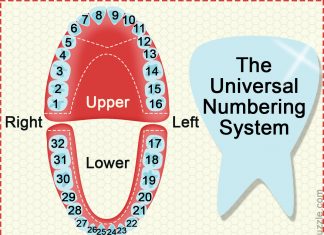
In dentistry, permanent and deciduous teeth are identified with the help of numbering systems. Here’s some information on the classification of the teeth and the popular numbering systems.
The front four teeth in the upper and lower jaw are called incisors. The two teeth in the center are called central incisors, whereas the teeth on either side of the central incisors are called lateral incisors. These help us in cutting or biting food. Canines, which are also called cuspids, are slightly pointed. These help in tearing food particles while chewing. Separated by the incisors, there are two canines each, in the upper and lower jaw. Four premolars are present in each dental arch. Two premolars are located behind each canine in both arches. These help us crush food while chewing. Molars are classified into first, second, and third molars. Normally, six molars are present in each dental arch. These are located behind the second premolar on both sides of each arch. These are bigger than the premolars, and help us grind food into smaller particles. The third molars are also referred to as wisdom teeth; not every person may develop wisdom teeth.
Deciduous teeth are the first set of 20 teeth that appear in childhood. It must be noted that children don’t have premolars. Only adults have premolars, which are a part of permanent teeth only.
It is believed that the first dental numbering system was proposed by a Hungarian dentist named Adolf Zsigmondy in 1861. Though more than twenty dental notation or tooth numbering systems have been developed over the years, most dentists use one of the three tooth numbering systems that are given below:
➠ Universal Numbering System (widely used by the dentists in the United States)
➠ Palmer Notation System
➠ FDI World Dental Federation Two-digit Notation (International)
All the adult teeth are numbered in this manner, even if the third molars or wisdom teeth have not yet erupted, or some of the teeth have been removed due to dental problems.
While adult teeth in each quadrant are numbered 1 to 8, the five deciduous (milk) teeth in each quadrant are indicated by A to E. Thus, number or letter for a particular type of tooth in the upper and lower jaw would be the same, but the symbol for the quadrant would be different. Right and left quadrants of the upper jaw would be denoted by ┘and└, respectively. On the other hand, the right and left quadrants of the lower jaw would be denoted by ┐and┌, respectively. Though the Palmer method was suggested for the purpose of dental notation earlier in the United States, the American Dental Association adopted the Universal numbering system, as it was easier to type due to the absence of symbols.
In case of the 20 milk teeth, the mouth is divided into four quadrants that are numbered from 5 to 8 in the clockwise direction, starting from the upper-right or right side of the upper jaw (central incisor to second primary molar), as observed by the dentist. Again, the child’s right would correspond to the left side of the dental chart. Every tooth is numbered on the basis of the quadrant and its position. So, in the upper-right quadrant, that is right side of the upper jaw starting from the central incisor, the central incisor will be numbered as 51, the next tooth or the lateral incisor in the first quadrant will be numbered 52. The numbering of the teeth in this quadrant will continue in this manner, till the second primary molar that will be numbered 55. Similarly, the teeth in the upper-left quadrant (central incisor to the second primary molar) or the left side of the upper jaw will be numbered as (61, 62, 63, 64, and 65). The teeth in the lower-left and lower-right quadrant would be numbered from 71 to 75 and 81 to 85 respectively.Though we would find it easier to refer to the specific names given to each tooth, dental charts or tooth numbering systems are tools used by the dentists to refer to the adult or primary teeth. If you look at the dental charts to understand the tooth numbering system, you will realize that the numbering system is not that difficult to understand.